Showing posts with label design. Show all posts

02 November 2015

Creative Good / Stuffed toys of favorite foods to help rural India, Part 2


Happy Bellies is a Kickstarter project bringing fuzzy version of favorite Indian foods into our arms, while delivering life-saving technologies to rural India.

Here's Part II of my conversation with Diana, one of the creative minds behind the initiative. We get candid about Happy Bellies and get a 'lil bit more personal.

If you missed it, check out Part I here.

///

Stop 3

We meandered over to Chinatown, since Diana was craving some quality Chinese food. We were pretty stuffed by that time, but couldn’t resist sitting down at Dim Sum Garden (1020 Race St.) ordering xiao long bao and sheng jian bao (steamed and pan-fried Shanghainese dumplings, respectively).

Me: What was your first exposure to Indian food? Or India?

Diana: I don’t remember … Indian food wasn’t something that my family ate regularly. My first actual exposure to the food was probably when I first studied abroad during college. That’s when I understood that there were different types of Indian foods, not just naan and chicken tikka masala. Every region has its own specialty. In South India where I was, they had the masala dosa, the idlis, the vadas, the filtered coffee -- all these very, very special things.

We then started talking about food poisoning, different regional foods, then diverged on a tangent to the documentary “Searching for General Tso.” Discussing the film lead us to comparisons between Indian and Chinese food and…

Happy Bellies, Chinese style?

If you were to make Happy Bellies out of Chinese food, what would you make?

That’s hard! You need to help me with that. Chinese food, like a distinct kind of shape… Like a char siu bao. People have already seen those on keychains, right. You can do it out of dimsum: har gaw, siu mai, char siu bao, chicken feet…

[I laugh] I don’t know about chicken feet. 

I guess you could make it out of dim sum, but it would be hard to make it out of a stir-fry. I don’t know how you’d make a Happy Belly stir-fry.

Unless you had a mini wok with smiling vegetables in it or something.

Haha yeah … Maybe a fortune cookie?

It’s true that some of it’s been done. For instance, I’ve seen dumpling keychains.

I have too. And I mean, they’re really cute and of course [East] Asians would do it first. They like everything cute. I don’t think Indians care about it as much.


You be the judge: Cute or no? via Happy Bellies

What is considered cute in India?

That’s a good question. I don’t think they have a good sense of that. Or, usually what many people think is cute, I think is tacky. Our soft toy manufacturer thought that nobody would buy our stuff. Hopefully that’s not the case, but we’ll see.

Why did he think that?
Because he thought, why would people buy food? He eats this stuff everyday. And so he said, You need to make it cuter, with big eyes and big features. You could just do that more. And we said no, this is how we wanted to do it. We thought this [way] was cute on a more subtle side.

Ooh yeah, ok. Design in India. Everything’s super flashy and colorful, patterned and not just nice Indian patterns like pretty paisleys and whatnot, but like bling in your face: too much color, too much sparkle. Being subtle is not really a thing.

So if the samosa were covered in sequins, maybe it would appeal more?

Appeal more to the mass Indian market? I don’t think that’s quite the audience.

Then who is the audience?

Maybe non-Indians who like Indian food and appreciate it. Indians abroad who miss this stuff and think it’s funny? People who have been to India and have eaten the foods and are like, that was awesome.

What is the aim besides raising money for Essmart?

Sharing our love for Indian food! And it’s also funny. [The characters] do come with educational cards but honestly, you’re not going to buy something you haven’t already experienced yourself. If you’ve never eaten an idli, you probably don’t want an idli because you would think, “That’s weird. I’ve never heard of it.”

I’m actually curious to eat one! And I’ve never tried an idli.

Really?

Yeah! Now I look at the toys and wonder what an idli tastes like.

I should get you an idli. We should go back to that chutney place [we passed earlier] and get one.

[We laugh.]

But yeah, there could be potential in Indian restaurants. The big chains might want to buy some and sell them as souvenirs. We could see them in the tourist market in India. But I’m not quite sure who the customer might be.

I guess that’s what Kickstarter is. An experiment. Have you ever done one?

Never done one before. We’ve done an Indiegogo [campaign], but Kickstarter is, like, you need to hit a goal in order to actually get all the money and be funded. So, it’s interesting because now we’re trying really hard to push.

So how have you been getting the word out?

Fortunately, we have a network. One of the girls who is on the team – Avantika, the Stanford product designer -- has West Coast networks, which is great. Jackie and I have East Coast networks. But, we want to go viral and we’re not quite sure how to get to that. Also, we’re not sure if it’s a product that can go viral so, who knows! 

So we’ve been tweeting, Facebook-ing, Instagram-ing, blogging, food touring, and going to Indian restaurants and food trucks to put up posters and talk to owners and have them promote our stuff as well. And then, I’ve been emailing a lot of food blogs, start-up blogs, and I even started looking at Asian American blogs because I’m Asian American.

Maybe you could find one of those YouTube stars. [See Part I for vague reference.]

[Gasp] Do you know any Indian American YouTube stars?

No, I know very few YouTube stars, if any at all. But that could be interesting.

Stop 4 

A craving for something refreshingly sweet to offset the savory spurred us to search for bubble tea. As we perched in the open storefront window of Tea Do (132 N. 10 St.), I asked a few final questions – really, the last ones this time.


Thanks, Josh!

So tell me more about learning to cook Indian food, after 3 years* of living there.

Right! I only have recipes because I don’t know how else to do it. I have Indian friends who put spices together and do something with it, but for me … I have no idea what turmeric by itself tastes like or what coriander powder by itself tastes like or what a garam masala is. How do you adjust the spices and in what proportions and how much do you put and how powerful is a teaspoon of all of these things? I just don’t know. So far, I’ve been following recipes and measuring out spices.

Where have you mostly been getting your recipes from?

There’s a cookbook that Hannah, my husband Josh’s sister, bought for him -- and I just took it. He wasn’t going to use it anyways. It’s very UK based.

The other cookbook I brought back from the US was pretty appropriate for the cooking implements that I have in India. Like, I bought a mixie recently. A mixie is like a grinder or a blender. It has different attachments that do different things, and every household has one. So, I have one now!

I do a lot of curries in general because I like curries. Chicken curries, usually.

You’re being saucy.

I like being saucy. I like sauces. I like rice. I still haven’t made a chapatti on my own yet, though. I’ve made chapattis at other people’s houses. They are little circle bread things made out of wheat flour, basically flour and water. You roll them out and put them on the [flat pan].

It sounds like lots of fun.

Yeah. You have to understand … Like as I was saying before, I didn’t grow up with Indian food. So I don’t know what flavor I’m actually aiming at, and I don’t know how to adjust the flavors, either. The dish I end up with isn’t authentic since I change parts of the recipes to make them better for my taste. Fortunately Josh, who is Indian, is not “pure.” He doesn’t really care as long as he can eat it. So I make my own type of food.

Tell me a little more about the spice box.

Oh, my spice box! I bought it at Metro, which is like the Costco of India. It’s like a Tupperware container but made of stainless steel, and inside there are seven bowls for spices and a little spoon. So far I put in turmeric, coriander, cumin, garam masala … I think I put in some fennel seeds. And cinnamon!

What I didn’t realize about spice boxes is the ease of cross contamination of my spices. I was telling you this earlier, but I make French toast pretty often and one day, I tried to use the cinnamon from my spice box. It ended up tasting like turmeric and other spices, like a masala French toast. French toast masala.

But that could be tasty!

Yeah… but not when you’re expecting something else. [laugh] So I realized if I wanted pure spice, I would have to take them directly from the packages they come in.

So, my spices! It’s really fun. And I think in Indian food you just mix spices anyways, so they only give you one spoon for everything.

Maybe it’s all about the mixing.

Yeah it’s all about the mix. The masala mix.

Is that what masala means?

Spices. Usually a mix of spices.

Interesting. So a tikka masala is…?

What’s tikka? I dunno. That’s evidently a British dish.

That’s what I’ve heard, too.

But it’s in India now. [in a singsong voice] Chicken tikka masala! Also in Minions.

Minions?

They say “tikka masala.”

///

* Note: Diana has actually been living in India for precisely 39 months.

To learn more or simply get your dose of cuteness and humor, head to the Happy Bellies Kickstarter page or their website.

///

“Creative Good” is a new series on creative ways to bring good to communities around the world. I love hearing about new initiatives, so if you have suggestions for a company, project, or person (or something else!) to profile, get in touch!

01 November 2015

Creative Good / Stuffed toys of favorite foods to help rural India, Part I

Imagine your favorite Indian restaurant: the spices in the air, the richness of curry, the crunch of samosas, the buttery-ness of fresh naan – all ending in a cozy food coma.

Ever wish you could extend that delicious comfort? Well, you can: in the form of cute and cuddly stuffed toys called Happy Bellies.

courtesy of Happy Bellies

Happy Bellies is a staff-picked Kickstarter project launched by three food lovers living in Bangalore – Diana, Jackie, and Avantika – who want you to be able to hug your favorite Indian foods, no matter where you live. The proceeds will go towards bringing life-changing technologies to villages in India, through Diana and Jackie’s non-profit Essmart Global.

** The campaign ends on November 3rd, so don’t wait to check it out! **

Diana is a close friend of mine from grad school and happened to be in Philly earlier this month. While we embarked on our own mini food crawl through Center City, we chatted about Happy Bellies, the different characters and crews, product design, and Diana’s efforts to learn Indian cookery – with plenty of tangents in between.

This is Part I of our meanderings, with Part II to follow.

///

Stop 1


We started at Metropolitan Bakery (262 S. 19th St.), a Philly mainstay. I wanted to try the millet muffin, which I had heard about on the podcast the Local Mouthful. While our conversation there wasn’t really quote-worthy for this post, we did have some laughs about AirBnB’s Obama O’s, YouTube stars, and savvy swag by presidential candidates.


Stop 2

Fried chicken and donuts? Yes please! The conversation got back on track at the Center City location of Federal Donuts (1632 Sansom St.), over za’atar-spiced fried chicken accompanied by a particularly delicious honey donut.

Me: How did you come up with the idea for Happy Bellies?

Diana: Actually, nobody on the team did. Esther, my college roommate, had come to India to visit me last year in August. We did this crazy all India tour, and we were eating a lot of food. I think we were in Shimla in north India, but were eating a south Indian food, idlis. She’s very visual -- and is also Asian and in architecture – so Esther was like, “Oh these look like little pillows! So cute!” And then, “What if we made them into little pillows?” That was the question.

What are idlis?

They are made out of fermented lentil and rice. So they’re like steamed rice cakes in a way, but a little sour. Idlis are a very popular south Indian breakfast food. But they’re kind of tasteless until they take on the flavor of the sauces. It kind of relates to the character ‘Lil Idlis. We made them little children because they have no taste of their own. They’re very impressionable.

So then how did you go from, “Maybe we should make them into pillows?” to starting an Essmart spinoff -- for lack of a better word?

I don’t think we took it seriously until June of this year. We were in a fundraising mode, trying to be creative and seeing if we can supplement our operations with something completely different. I don’t know if there’s quite a market for it, but it’s fun and ridiculous – kind of like us.

Where did the name Happy Bellies come from?

I think we ripped it off of somebody.

[We laugh]

There’s this bakery near our office that’s called Happy Belly Bakes. It’s one of my favorite bakeries because they have amazing cupcakes, my favorite being the banana walnut cupcake.

There’s also a thing called “Delhi belly,”when you go to India and you eat the food and get diarrhea. It’s really bad. So, we’re still dealing with Indian foods but we are in contrast to Delhi belly. We are Happy Bellies! Yay!

So how did you pick out which foods to highlight and make into characters?

We chose the foods mostly based on their shape – and, I guess, how well known they are. I mean, personally my favorite food is not on the list. It would be a chicken kotu parotta.

What is that?

A parotta is south Indian, sometimes called a Kerala parotta. It’s a flatbread that’s layered and really rich. Like a flat croissant. I don't know how to explain it… It’s awesome. It’s like really oily, full of ghee and made up of a lot of layers.

And what do you eat that with?

Usually it comes with some kind of korma, like a veggie curry. But the way I eat it is kothu parotta. “Kothu” means “cut.” So, on a flat area, [chefs] take this stainless steel cup and they go boomboom-boomboom-boomboom-boomboom-boom and they chop up the parotta. Then they mix in egg and chicken and masala spices and cilantro. It’s so good. The first time I ate it, it reminded me of [Chinese] chow fun.

Ooh, interesting!

I was like, “Oh my gosh!” And the best one I’ve ever had was in Polachi, Tamil-Nadu, down south close to the Kerala border. The parottas are crispier there. It’s ridiculous. So good. But … chopped up dough and chicken don’t make a good stuffed animal.

It doesn’t look like anything.

Likewise, you can’t do a gravy, like a butter chicken or --

Or a tandoori chicken.

Yeah, that doesn’t look like a good stuffed toy.

[We both laugh.]


But what do look good are south Indian breakfast foods, which is a cuisine all in itself so you need to honor it. [Our characters] are the trinity, the triumvirate of the south Indian breakfast foods. Like the masala dosa, which is similar to an idli but the batter isn’t as fermented. It’s like a crepe with potatoes inside. We named it Dozing Dosa because it makes you really sleepy after you eat it.

I like that name.

Yes, it’s very cute. And then we have idli because it’s also classic, and they’re really cute.

Then vada. They’re kind of like savory donuts. We made them Auntie and Uncle Vada because vada are something that oftentimes people make at home and serve around teatime. They could also be a morning thing, but we needed something to represent south Indian hospitality.

Everyone also seems to be an auntie and uncle.

Yup! That’s true. If you don’t know the name of your elder, just call them auntie and uncle and that’s perfectly fine.

So we chose those [three]. For our other crews - our other groups - we had wanted to do, for example, something based on foods in Kerala because they’re really funny-looking. But we decided not to do that because nobody knows what they are outside of India -- like an appam, or an idiyappam. We ended up going with the street foods because they’re a bit more famous.

We had to do a samosa. Even though I don’t really eat that many samosas when I’m in India, everyone knows what a samosa is. So we made it Superstar Samosa for that reason ‘cause it’s so famous. And then jalebi wasn’t on our list initially –

Is that the one that looks like – no offense --

It looks like poop!

I was gonna say worms!

It’s basically deep-fried dough coated in a sugary syrup. Our first iteration of the jalebi was much thinner, much more like jalebi. But we wanted it to be cuddlier, so we asked the manufacturer to stuff it more. Then it started to look like a pile of poop, and now… We’re going to change the dimensions. It needs to be cuddly but can’t look disgusting.

[We both laugh]

Then we chose pani puri, which are little fried crispy balls that are filled with flavored water.

Now, do you have a favorite character?

It’s hard to say. [pause] On the website, I wrote that it was the idli because Avantika already took the dosa. I would get the dosa, though. It’s the cutest and most accurate. The idlis are also very cute, but our first prototypes were closer to life size, which I thought were adorable. But we made them larger so that all together they’re like a cushion. I’m not quite sure how I feel about it.

So when we sent our stuff to the designer, our manufacturer –

What kind of manufacturer are you working with?

He’s a soft toy manufacturer. We just Googled a lot and found a guy in Bangalore who was actually decently responsive.

Are they all handmade?

[The fabric] is cut with machines but the embroidery is hand done.

How are you hoping that the Kickstarter will relate to Essmart, either in the short-term or the long-term?

In the short-term, fundraising. We’re funding it out of Essmart money and we’ll take all the proceeds back to Essmart as a revenue stream. Will it be a long-term thing? I have no idea. If it’s successful and people want to buy them, who knows, maybe we’ll set up another company and sell it. But right now we’re just seeing where the Kickstarter goes, and if there’s interest.

///

Check out Part II for more on Happy Bellies, glitter and sparkles, 
the struggles of cooking Indian food, and more.

To learn more or simply get your dose of cuteness and humor, head to the Happy Bellies Kickstarter page or their website.

///

“Creative Good” is a new series on creative ways to bring good to communities around the world. I love hearing about new initiatives, so if you have suggestions for a company, project, or person (or something else!) to profile, get in touch!


18 August 2012

Students finally able to "duck and cover"


A student and his professor at Bezalel Academy of Art and Design in Jerusalem have designed a desk that can withstand 1 tonne of vertical force -- what they call an "earthquake proof table" that students can use to "duck and cover" during an earthquake.

It seems like an interesting concept, especially in developing countries where building construction is often sub-par.  However, the article featured on GOOD suggests that these tables can substitute for the more costly measures of wall reinforcement or reconstructing schools to be more earthquake-resistant.  While I agree that this kind of furniture could save lives and save money in light of more difficult infrastructural and architectural changes, I wonder if it might become a way to not improve construction methods because desks essentially provide the safe roof overhead.

The table is still a pretty great design innovation, in spite of these larger questions of feasibility and intention in the longer run.   It's also certainly creative and makes me rethink what really is part of the build environment that can be leveraged for life safety while being well designed.

03 August 2011

Food's flight patterns

via irresistable
A recent grad in graphic design, James Reynolds devised an alternative to traditional produce labels that inform consumers about just how far those Argentinian tomatoes really traveled to get to your store - and plate.  Would the "Far Food" project change people's buying habits?

19 July 2011

High Line : Part deux

via Architectural Record
“We like to think of it as a place where people revel in doing nothing, which is an anomaly for New Yorkers.  It has an unscripted, unintended, unprogrammed timelessness. You just get lost in there."
// Liz Diller, in the NYTimes article
anticipating the opening of Section 2 of the High Line

Has anyone seen it yet?  (Some people clearly have.)

06 July 2011

Figure 8s

I'm not sure what to think about videos like this that highlight a building walk-through in such a 'cool' way (with requisite lounge music), but don't say much about the actual experience of living in such a place where the figural aspects of the building itself (shaped like an 8, like the diagram) means a very long road from one's flat to the parking lot.

Then again, I still like the scenic promenade (supposed to be for cyclists), so the walk-through as a convincing visualization tool works.

- - -
Bjarke Ingles Group
8 House
2010 / nearly completed

09 June 2011

Once upon a time in NYC...

... there were mundane objects lying around the city we call the City, waiting to be noticed.  Items like the window air conditioner...


... the steam vent ...

... the ubiquitous hot dog vendor ...


... and more simply pined for attention.  Which they got.  When the Department of Benign Violations came along.

Suddenly the streets were filled with music.  People chilled (or heated) at bus stops and bicycle racks.  Facades were covered with inflatables, transformative louvers, and even erupted with balloons.  Trees moved to the song of hot dogs sizzling.  Rooftops blossomed.  Taxis buzzed with electrostatic energy and removed the lint off of the sweaters of passersby.  And the streets of NYC were forever changed.

26 February 2011

Barbie as career adviser

via GOOD Design

I never thought that Barbie was so influential in directing girls' career paths until seeing this blog post that Fennie forwarded me, talking about the upcoming release of Architect Barbie as a response to the lack of women who stay in the profession.

This discussion about the disproportionate number of women in architecture school vs. in the office started, for me, while I was in the workplace.  My architecture firm at the time had a pretty generous policy for mothers in terms of flexible maternity leave and a reasonable work-life balance, although I learned that this was not the norm.  I greatly admired my coworkers who managed to raise toddler children while holding significant positions at the company and balancing the professional career of their husbands (incidentally, also architects).  How could they handle it?  It was only through the grace of company policy (as they put it) that made it possible, along with a love for architecture.

Others haven't been so optimistic nor as fortunate.  In college when I told family friends I wanted to go into architecture, many of them cautioned me against it.  The number one reason?  Zero family life.  I can see this to be true even in the lives of some of our faculty.  At the beginning, work comes first.  It's only after their careers have been firmly established - and the long hours of devotion to projects and clients put in - that they finally then have children.  Others don't stick with it so well, which is why in practice, only about 10-15% of firms are women.

Will Architect Barbie make a difference?  For one thing, her wardrobe doesn't speak to a true architect's garb.  She might have the right glasses, but not the right colors (or rather, lack of color).  She should also be holding an Xacto knife and have a laptop slung over her shoulder rather than a document tube.  Maybe some bandaids over her fingers from cutting herself with said blade would be realistic as well.  Oh wait, that would make her MArch Barbie and not at all reflective of the field.

Back at square one.

04 February 2011

02 November 2010

Textures of MIT

In the last FAST class, we presented ideas for neuroscience based installations, stemming from a presentation by Professor Pawan Sinha, from the Brain and Cog department, about his research on visual neuroscience, or visualizations of how the brain learns to see and process information.  My summary doesn't do his research justice, so it might be better just to watch his TED talk instead for some very cool demonstrations of his work as applied through his non-profit in India.

In any rate, our group was massive (5 architecture students plus 1 musicology student) and we generated 3 project ideas for last week.  Kelly and I worked on one of them, which was based on the brain's gradual process of deciphering an image from its parts to the whole (particularly at the moment when a blind person regains eyesight and the brain needs to learn to see).  In this, we conceived of a texturized wall with a blank digital surface on top that people could press or rub in order to reveal the image beneath.  At first the textures would be abstract patches, but over time and from a distance, the overall image would be recognized as more people participate.

The original example image, with outlines extracting its principal elements :


Various texture abstractions of the image, with each combination affecting how one perceives the actual result :


Image of the potential installation wall :
If digitized, the image behind could change and potentially be "layered," like Old Masters paintings that have been concealed by other paintings and can only be revealed by careful stripping.  (Hm...hopefully that reference makes sense.  See the Thomas Crown Affair if not.)  In class, we  discussed potentially having the rate at which someone rubbed the wall affect the image that is revealed underneath, so that a series of images could be revealed at once that would tell a narrative relating to MIT's history or future trajectory.

This is a bit abstract, but of course, I'm procrastinating from my current work by writing this post about my work... and this is still a theoretical project.  By tomorrow, we need to conceive of a final project idea, so we'll see what comes of that.

26 October 2010

2011 FAST Odyssey


For the FAST class, a group of us made a stop motion animation describing a potential installation we would design and make on the three intake stacks next to Building 18.  They're normally somewhat invisible within the MIT campus, so we decided to design the installation around the idea of calling attention to this industrial infrastructure by making them into mini stages for showcases using air, light, and sound to create space above.  Kelly, myself, and Yushiro each drew part of the animation, while Travis put it all together in Photoshop :


Left : visualization of sound (hitting a drum head corresponds to a puff of smoke in one direction or the other)

Center : play of light and shadow (fog becomes a curtain on which an image can be projected, with people able to play and cast shadows both while outside and inside the circle)

Right : visible air movement (jumping on the vents causes the fog machine to rise and fall, creating a denser atmosphere when closer to the ground or a more translucent one when higher up)

We've been brainstorming various installation ideas, so we'll see what ends up being built for next year's MIT 150.

20 October 2010

A place to rest one's head -


- only.

When looking up examples of capsule hotels, which is a Japanese idiosyncrasy and result of ultra optimization of space, I came across this one called Nine Hours - named for the time it takes for you to sleep and get ready.  Although it looks more like a wall of ovens (or worse, a wall of graves) rather than a wall of beds, what caught my eye was actually the list of rules on their website, which are as follows:

9h may refuse the conclusion of the contract in any of the following cases.
  • When 9h is fully booked and no sleeping pods are available.
  • When 9h is unable to provide accommodation due to natural calamities,
    malfunction of the facilities or other unavoidable causes.
  • Services beyond those provided are requested.
  • When the Guest seeking accommodation is deemed liable to act in violation of public morals,
    or conduct their selves in a disorderly manner.
  • When it is obviously acknowledged that the Guest is an infectious case.
  • When the Guest is heavily-intoxicated. This applies even after Check-in.
  • When the Guest speaks or acts in a manner that is deemed an annoyance to other guests.
  • When the Guest seeking accommodation is a member of, or involved with, gang organizations,
    crime syndicates or any antisocial groups.
  • When the Guest speaks or acts in a manner that is deemed an annoyance to other guests.
  • If 9h terminates the contract when the circumstances come under any of the above mentioned articles,
    9h will not charge the Guest for any of the services in future during the contractual period which he/she has not received.
Hilarious.... and somewhat disturbing at the same time.  The website says explicitly that the floors and elevators are separated by gender as well.  This makes me wonder what type of person uses these sorts of hotels - not simply business people on the go?  Does the architecture encourage the kinds of behavior of the guests, or the other way around?  Does morality fit into the picture?

In any rate, I don't think this is exactly what Kisho Kurokawa, architect of the Nakagin Capsule Tower, had intended when he built the first of capsule hotels in the 1970s, more under the premise of accommodating change and recyclability within architecture as part of the Metabolist movement.

    05 September 2010

    The ladies of the "house"

    I'm already having slightly dismal thoughts about my ability to upkeep this blog during the semester, but let's not disappoint ahead of ourselves.  The last 2 weeks of being back at school have been filled with multiple responsibilities that come with being a graduate resident tutor for undergrad ladies, one of them being the making of door tags :


    I must say that I'm quite proud of them, although they did take quite a bit more time than I had anticipated to make.  (If only I had taken advantage of someone's laser cutter privileges, these 49 tags would have zipped by...alas.)  To be honest, though, it gave me quite a bit of joy to hand cut and glue these babies - as a gesture of love and care for my residents, even though I haven't met them or have only known them for a short amount of time.  (I mean this in the most honest and non-sentimental way possible.)

    To use pre-existing materials and not have to print anything or buy extra supplies, I had rummaged through my architectural supplies and ended up cutting up some pieces of old museum board and gluing on strips of color/texture, which were sliced from old magazine ads and photos.  (If you look closely, you'll be able to tell.)  Then I wrote their names in charcoal, although didn't remember to buy any spray fix, so they can still smudge if touched.

    The girls were sweet, with some of them leaving me messages on my whiteboard or coming by to convey their appreciation.  One of them, who doesn't even live on my floor, asked if she could have one as well.  Ah, the ultimate complement :]  I realized it's small labors like these that make a difference, little steps towards creating a sense of home.

    Next task: brainstorming a good first meeting sweet delight.

    25 August 2010

    For the love of breakfast


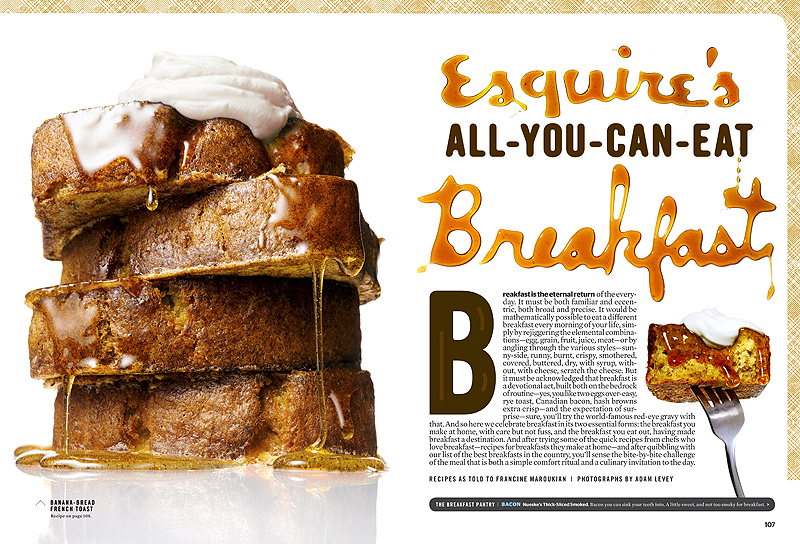
    New York graphic designer Erin Jang's post on this series of breakfast spreads for Esquire magazine looked so delicious, I instantly wanted to make breakfast.

    ...Which I will do after concluding this post.

    ...Which brings me to my reoccurring hobby and constant delight in making breakfast, eating breakfast, and thinking about whatever else having to do with breakfast (including the entire Joie de Vivre line of egg products, of which Jen and Eric probably own at least half !!). I'm not sure when I first discovered this love, but it is my favorite meal of the day and one of my beloved ways to celebrate the weekend, the end of the term, or just being with friends.

    Eggs are an essential part of the whole ensemble and a part I think I need to work a bit on in terms of culinary versatility. But why eggs? Although they're said to be a mere baby step in the world of cooking (i.e. "at least he can fry an egg"), take Julia Child for example: her instructor at the Cordon Bleu in Paris made her go through 15+ iterations before declaring she could make a single egg correctly and could move on to omelets (omelettes?).

    Practice with the simple makes the complex perfect, I suppose.

    06 June 2010

    [HK 5] : An architectural kind of day

    Yesterday I met up with a slew of MIT people - Jordan, Mavis, Otto, Kian (and later bumped into 4 more) - to go to the Hong Kong University final thesis reviews.  10 MArch students had been chosen to re-present their work in a public review, with over 10 critics on the jury (including some from our side of the world like Preston Scott Cohen).  I would be intimidated, but they (for the most part) kept their cool.


    One thing I noticed and discussed with M+O was the difference in representation style between HKU and what's typical at MIT (and maybe other American universities).  Back at home, we steer towards formatted boards with huge renderings, stacks of diagrams, and everything plotted.  Here, the presentation is quite densely packed, with smaller drawings, an assortment of paper sizes, and quite a bit of mixed media.  Although some of it was a bit too hodgepodge for my taste, in general I really appreciated the variety in representational expression.  Each person really seemed to have their own style (if you will) that was quite distinct and didn't necessarily shout "Illustrator!" or "Photoshop filters!"  Our students (including myself) could probably learn a thing or two about developing distinct ways of representing our work, so that we don't all look the same and thus generic.

    An interesting additional fact: HKU might have the cheapest Starbucks in Hong Kong!

    A new summer special only found here: black sesame green tea frap, yum!

    To complete the architecture sort of day, Jordan and I went to Foster's HSBC tower on Queen's Road, which has a cool central atrium and escalator connecting to it from underneath.  I later found this cool facade while walking towards Central:


    Also on my list is Pacific Place, which is supposed to have awesomely designed bathrooms.

    31 May 2010

    An Ex-vaulting experience

    The massive crowd of designers and donors at the preview

    I figured I should recap on a previous adventure closer to home before heading overseas.  I had talked about the vault sighting at the Cooper-Hewitt, but the preview reception came and went as a milestone in MIT MRG's book (Masonry Research Group - yeah, we came up with a name instead of perpetually calling ourselves "the Team").

    As I mentioned before, the group had been working on this project since last spring, so I was really looking forward to actually seeing the vault in person.  Walking into the CH that night of the 13th was a surreal experience.  Not everyone on the team could make it, which was a shame, but it was still a very festive (and cacophonous) night.  The museum was absolutely PACKED.  It's moments like these when I truly lament being short, since most people's armpits are at my nose level and it's difficult to get people to notice that I'm trying to push past without jabbing them in the ribs with some generous elbow movements.

    And then,


    A little walk-through leading up to :


    Perhaps the other photos look better, but somehow this is special because I took it in person.  The vault in all her arching splendor!  So unassuming and light yet heavy with the hours of work involved in getting those catenaries just right and the bricks laid with minimal mortar wasted.

    This vault need not go on a diet - she's so thin already!


    And of course, you can't leave without taking at least one (or more...) silly pictures, here with Flo as my partner-in-crime.  No worries, though - the vault can't be destroyed with a mere push by a small one like me.  You need a couple sledgehammers and many minutes of sweat to make the footings budge.


    One of the most surreal aspects of the event was seeing our names on the wall plaque, and then going around the exhibition and seeing other well-known names we also recognized: MVRDV, FOA, KTA, Norman Foster...  and MIT MRG.  Although it was cool sitting virtually side by side with these architects and their firms, one major difference stood out: most of them had renderings, models, or other forms of representation for their buildings, whereas we had a full scale installation.  KTA did have a massive wall section of their Loblolly house there, which was cool to see, but I would have expected more 1:1 mockups or at least larger scaled prototypes than the typical renderings you would see in a magazine or monograph.

    There are too many other cool projects within the overall "Why Design Now?" exhibition, but one that I thought was semi-insane yet admirably intricate was this sweater:


    Look closely.  Yes, it's made from those little plastic tags retailers use to attach price tags to clothing.  Now that's what I call attention to detail in reuse before recycling.

    20 April 2010

    The graphic designer's new best friend


    As a typeface lover and one who agonizes over what font will make my presentation boards/portfolio/poster look the best, this is a hilarious way to make decisions. (Click the graphic to view a larger version.) I followed some of the flowchart and just laughed at what I came across, like:

    "Do people find you boring from time to time?" >> Times

    or

    "Are you alone?" "Follow me..." >> Comic Sans [one that I really can't stand]

    There were also some paths and ultimate typeface choices that surprised me as well. Maybe I have a thing or two to learn after all, or maybe this chart just exposes how subjective font choice really can be.

    29 November 2009

    Playing with colors

    I've been playing with my blog template. It's still not really what I want it to look like (not terribly minimalistic), but it's a bit of a change. Feel free to leave comments in this intermediate stage.

    01 September 2009

    early registration?

    As a side project, I'm designing the wedding programs for one of my friends at MIT. I was just poking around theknot.com, looking at some examples for bursts of inspiration, but after a few minutes just about every other page was encouraging me to register for a free account on the website.

    This made me snort, but then I stopped and thought about it. It occurred to me that, if I registered, I would pretty much be labeling myself as a would-be bride, when that's clearly far from the case. (Really reee-ally far.) But I suppose it's true that, over even just the last year or so, I've become so saturated with wedding culture. My friend Kaitlyn once remarked that I might have been to more weddings than any of her friends - this came after she asked for design advice and lead into a lengthier discussion on how not to have a boring wedding. (More on that later.)

    Oh, funny... Although I can't help but think to myself, "Hm...I like that, don't like that, like that..." when I observe or see various things at different weddings, it's probably best to lay most of that thinking aside. The proper time will come when it's my turn - but until then, I'm content to play a small part in my friends' happiness, even if it's in a graphic sort of way.

    Anyways, as I work on my current project (part of my "moonlighting" after the vault during the day, I guess), here's a mini snapshot of the programs I designed for my lovely college friend Jackie, who got married just a couple weeks ago and is now Mrs. Vary (!!!):


    [note: the image quality here isn't very good - I'm not sure why it is, since the original files are fine, but it gives a picture.]