Showing posts with label articles. Show all posts

17 February 2017

Miscellanea, etc. / 17 Feb 2017


I've had a string of flare ups in the last couple weeks and have been spending more time at home than I would have hoped. Thanks to technology, though, here is a smattering of miscellanea that has kept me occupied in my couch-bound days:

/ / /

_ SCARS ARE BEAUTIFUL

Rachel Sussman, “Study for Sidewalk Kintsukuroi #01 (New Haven, Connecticut)” (via Hyperallergic)
“Cracks represent something in need of attention, and the surfaces we walk, bike, and drive over are usually overlooked until they’re in truly critical condition,” Sussman said. “By gilding them, it’s a way to see what’s around us with fresh eyes and to celebrate perseverance.”
Artist Rachel Sussman takes the Japanese tradition of kintsukuroi, repairing ceramics with gold, to the more macro scale of the floor, the sidewalk. I can't help but be drawn to her careful attention to the scars in our cities. Her work is currently part of an exhibition on gold at the Des Moines Art Center. (via Hyperallergic; emphasis my own)

01 December 2016

Miscellanea, etc. / 01 Dec 2016


Even though Christmas music has been blasting in stores since mid- or even early November, I haven't been ready. Hearing Mariah Carey belting "All I want for Christmas is yooooooou" typically brings me delight (particularly in this context), but these days I cringe. Forget "Jingle Bell Rock." My ears are only ready for gentler seasonal music like the Nutcracker suite, or possibly Vince Guaraldi's jazzy Peanuts Christmas soundtrack. That's about it.

I'm not usually a grinch by any means, as Christmas is one of my favorite times of the year for festive and religious reasons. I've just been tired of the overflowing intensity of the news cycle and our world in general. First there was the election and the frenzy leading up to it -- now still ongoing. Then Thanksgiving whirled by, with the holiday-ness of the holiday season being thrust upon us without as much as a pause.

But perhaps December 1st and the creeping crescendo of cold weather makes it more "okay" to embrace winter and Christmas to come. I am slowly coming around to it. It feels more okay not to be "ready." Advent started this past Sunday for many Christians, and I am embracing the side of it that is about the long journey to Bethlehem.

So as a reflection of my (and perhaps your) mixed state, in this edition of miscellanea you'll find some articles about and not about the holidays:

09 August 2016

Late night tracks / Fantastic Negrito


These days if I can't fall asleep, the last thing I want to do is stare at a computer screen. There are all kinds of studies these days that talk about the havoc wreaked by screens and modern electronics on our sleep cycles (for teens and the rest of us).

But here I am again, and my music of choice tonight is Fantastic Negrito. I might have first heard about him on NPR, but those are vague recollections. It was his first single, "About a Bird" (above), that hauntingly drew me in. I bookmarked it. I also bookmarked an article on Consequence of Sound, detailing his life story and the genesis of his album The Last Days of Oakland. I read it. I was intrigued. I then kept going, listening to the album in its entirety. I took a chance on him.

27 January 2014

Normalizing Wonder Woman

A new year, new resolutions, and new reads.  A quote that recently struck me:

"I realized that there was a power in telling these goofy, crazy, messy stories from my life. I started experimenting with that mode of storytelling in the book. It was therapy for me, first of all, to put some of this stuff on paper. But I think it worked, at some level. What I’ve heard from many readers of the book is that it validated some of their own struggles. That has been a good thing for me to hear. It was scary to put some of this stuff out there. But I think what I began to understand when I was writing it, and I’ve definitely understood since the book came out, is that everybody has these stories. Everybody has the breast pump. Everybody has the moments where they are ready to kill their husband and their hair is horrible. They are blowing the presentation because their kid had to poop last night. The more we can get these stories out there without turning this into a massive sobbing event, it just normalizes the image of Wonder Woman, which is a much better place to be than perpetuating this myth of perfection."

Debora Spar, president of Barnard College
Interview by Knowledge@Wharton, "Debora Spar on Women’s (Impossible) Quest for Perfection"


Last summer, I started writing a life update.  Now, I'm still writing it and hopefully will finish soon.  Spar's interview reminded me that we all, do indeed, have these crazy stories from our imperfect lives.  It hasn't been easy for me to write this update, especially since my goal is to somehow express in a coherent, non-sentimental, yet honest way of how my last 2 years have been, especially in struggles related to health.  It's hard to write about this stuff.  It's messy.  I've written so many drafts and not even bothered to proofread my earlier versions because they sounded so not like how I wanted to sound.  But accounts like Spar's and others motivate me.  Writing has been a type of therapy -- getting thoughts down on paper (or screen), figuring out to share them, validating that they are personal and valuable.  Each word written is another step in the right direction.

22 March 2013

What you know when traveling

"In Beijing, the joke among hacks is that, after the drive in from the airport, you are ready to write a column; after a month, you feel the stirrings of an idea-book; but after a year, you struggle to write anything at all, because you’ve finally discovered just how much you don’t know."

From "On Slow Journalism" by Evan Osnos in the New Yorker

28 June 2012

Misplaced audience + other news


“Sometimes, I can’t tell if they’re talking to potential clients, or to other architects.”

marketing consultant Richard Staub, 
in response to star-chitects' websites with too much opaque language, aka "archispeak"

My answer: They're probably talking to architecture students.


Other articles of note:

-- Forbes' coverage of the rise of women entrepreneurs
-- Huffington Post on the perpetuating salary gender gap
-- Hoping to be more productive?  Me too!  Some tips from the NYTimes Small Business Summit
-- Using boredom to our advantage in the 99% blog post on its connections with creativity

15 May 2012

Not by map, but by sight


I came across this intriguing essay in The Atlantic / Cities :

How Do You Navigate a City with No Street Names?

The place in question is Amman, Jordan, a labyrinth of nameless streets and alleyways.  I love the anecdote the author uses to illustrate the problem of navigation:

"It's totally normal to be lost and confused," says photographer Regina Mamou, who spent a year studying how the people of Amman get around. Once, she remembers getting directions to a party via a map the hostess had Photoshopped herself. "I had recreated it on this Post-it, and i still couldn't get to her house," she says.Finally, her friend climbed to the roof of her building and called for her. "There's a sense that this was totally normal," Mamou says. "The fact that we have to get on top of a roof and shout down." 

Here, it's all about the landmarks.  These are the primary nodes of navigation based on visual and experiential memory, not the rational memory of street names and gridlines.

Reading this reminded me of being in Port-au-Prince.  From the very moment M and I hopped in the taxi from the airport to the Haiti Communitere compound, we were told again and again that the best way to orient people to the place was not to tell them we lived on Rue Pelican in Clercine, but that we were staying across from the Jedco.  (As far as I could tell, Jedco deals with industrial-scaled cleaning and management of sorts.)

And you know what?  It worked every time.  Moto drivers (basically taxis for 1-2+ people) never ceased to know where we wanted to go if we were going back -- it was more the going out that was tricky.  Gotta learn the landmarks.  There's something really meaningful and simple about that.

02 May 2012

Staring London in the eye

A bus advert that had amused me all those years ago.
A no-nonsense anti-guide to London (one of our honeymoon stops):
"... You want stiff-lipped men in bowler hats and cheeky cockneys with their thumbs in their waistcoats and fish on their heads. 
I’m sorry, but they’re not here anymore. No city’s exported image lags so far behind its homegrown veracity than London’s, so let’s start with what you’re not going to find. We’re all out of cheeky cockneys, pearly kings and their queens, and costermongers. You’re not going to find ’60s psychedelia and the Beatles in Carnaby Street. There aren’t any punks under 50 on the King’s Road; there are no more tweedy, mustachioed, closeted gay writers in Bloomsbury, no Harry Potter at King’s Cross. There aren’t men in white tie, smoking cigars outside Pall Mall clubs and there isn’t any fog, but you can find Sherlock Holmes’s house on Baker Street." 
// A.A. Gill, in his NYTimes' article "A Profile of London"
 What ... no fog?!  No fish on cockneys' heads?!

Just kidding.  The fog part (amongst other things) I can attest to firsthand.  I was studying abroad in Paris in the spring of 2005.  For our semester break, I ventured to London to visit my friend Jackie.  Paris had been dulled by constant rain and clouds, but just as my plane crossed the Channel, the skies broke open and I was greeted by all sun and cheer in the UK.  Talk about breaking stereotypes.

At least we'll be able to find Sherlock.  Phew.

- - -
As a little epilogue, another photo from the past, evidence that London - although perhaps not so foggy - is still indeed windy:

From the top of St. Paul's - a long but worthy hike for the view.

18 April 2012

[the big day] The bling and the dress

Sorry for the recent silence, but recent health issues coupled with that thing called "thesis" and that other thing called "wedding planning" have put updates on the life back burner.

But recently, I've come across 2 articles that have made me further question the traditions of the wedding industry.  Before starting to plan my own wedding, I had helped out with the pre-nuptials of family and friends and had my fair share of drama, adrenaline, and the like.  Planning your own wedding, though, really pulls the curtain away to expose what's really going on in that machine called the wedding industry, or what we couples call "the biggest day of our lives."

Don't get me wrong: I really love my fiance and am very much looking forward to tying the knot in November.  However, in this whole process I've been questioning the who/what/when/where/why/how, like ...
Why must I wear white?  Why do brides wear veils?  How is it that a single plate at a dinner banquet is more expensive than a fancy French restaurant dinner, yet the food isn't as good?

Here are two featured links that discuss some of the most critical 'wow' wedding items :

// The economic story behind the bling (outside of DeBeers) //
The Atlantic / thanks to Anne!

// Why that white frock costs so much when you wear it once //
Slate / thanks to Stef!


30 December 2011

Be still

I came across this recent NYTimes Opinion piece and found it quite insightful, especially during the Christmas holiday time leading up to New Year's Day when we are split between the frenzy of gifts and company and the reflection of resolutions and years-in-review.  This quote struck me in particular:
"When telegraphs and trains brought in the idea that convenience was more important than content — and speedier means could make up for unimproved ends — Henry David Thoreau reminded us that “the man whose horse trots a mile in a minute does not carry the most important messages.” Even half a century ago, Marshall McLuhan, who came closer than most to seeing what was coming, warned, “When things come at you very fast, naturally you lose touch with yourself.” Thomas Merton struck a chord with millions, by not just noting that “Man was made for the highest activity, which is, in fact, his rest,” but by also acting on it, and stepping out of the rat race and into a Cistercian cloister."

// Pico Iyer, "The Joy of Quiet," 29 Dec 2011
Perhaps this is a secular call to a Sabbath?

Being in graduate school in architecture has made the idea and practice of rest both one of my greatest longings as well as the greatest challenges to achieve when surrounded by pressures to be productive - every moment of every day.  Simply taking time out of the day to pray, to read a leisure book, to take a quick walk outside, to eat a full meal at the table with no distractions or multitasking - are challenges to the idea of "pressing on," but I've realized are disciplines that can make me more productive and less strained, if I choose to do them.

I still need to reflect on this past year and this past semester in particular, but one thing I know is that I don't want to repeat the anxious frenzy that characterized my fall, but remember the "joy of quiet" even in the midst of work and busyness for the spring.

21 September 2011

Be serious or paranoid?

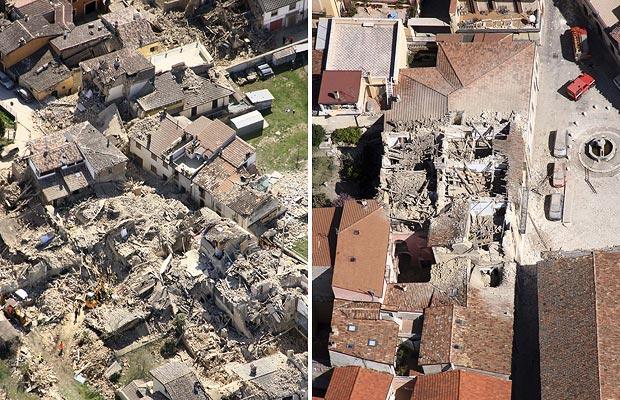
 from Times Online aerial photos

As we in Boston saw with Hurricane Irene, sometimes official predictions of natural hazards and preparations outweigh what actually ends up happening.  Girls in my dorm were decidedly underwhelmed by the winds and rain, leading to a general skepticism about "the boy who cried wolf."

But in other cases such as the L'Aquila earthquake in 2009, seismologists are being charged with manslaughter for NOT being serious enough about the data received before the quake.  An article in The Chronicle of Higher Education describes the start of the trial, leading to questions about the exactness of predictions and human attitudes towards hazards.


Is it paranoia or preparedness?

This semester I am taking a course with Prof. Jim Wescoat, Disaster Resilient Design, which lays out a theoretical and practical framework for thinking about and applying these issues.

The topic also fits in with my thesis and makes me consider the role and responsibility of professionals and academics is within the field, as well as what it really means to "build back better."  This last phrase is thrown around so much by NGOs, the government, and whoever else is involved in Haiti or elsewhere.  Is "better" an objective or subjective term?  If it's the latter, who determines it?  How can we know if one strategy is successful without 'testing' it in the next big quake/fire/hurricane/famine, etc.?

Although I can't address all (or even some) of these questions within the scope of a one-semester MArch thesis, it's worth mulling over in the back of my brain.

18 July 2011

Don't talk, just do

"... it’s true that when we talk about our work, we give ourselves the feeling that we are working on something when truthfully, we aren’t."

and other thoughts on creativity from Donald Miller,
author of Blue Like Jazz

10 June 2011

Gratitude ... of sorts

 “Thank you, first sheet of a new toilet paper roll that won’t tear off evenly so I have to scratch and claw and shred three layers of the roll just to get the thing started. But that’s cool. I think I’ll have the last laugh, since I know where you’re ending up."

From "Thank You Notes" by Jimmy Fallon, recently published and quoted in the NYTimes

Maybe it IS easy to write a book after all ...

25 May 2011

Summer reading list

from two summers ago, a lovely retreat to an urban beach
"The best summer reading I did in the past was in 1993 — I was working my butt off at a Chinese restaurant in Tuscaloosa, Ala., but I stole some time to read Ezra Pound, Emily Dickinson and William Faulkner on the greasy kitchen floor. Literature had never been tastier."
- Yunte Huang,
author of Charlie Chan: The Untold Story of the Honorable Detective
and His Rendezvous with American History
This great quote, from a compilation of authors' summer reading reflections, really encapsulates my attitude towards summer reading.  Although I don't always enjoy it with greasy Chinese food, the tastiness of words when you have the luxury of time to enjoy them is a sensation that I really miss during the hectic semester.

I haven't yet put together my own list of summer reads yet, although I imagine it may include some travel narratives, catching up on a peppering of blogs, Haitian Creole lessons, a beta read of a friend's new fantasy novel, maybe some foodie Michael Pollan or brainy Oliver Sachs... and/or countless selections from the many books on my shelf here at home that I've picked up over the years at library and sidewalk book sales but have yet to read.  (That last category will likely take me several summers to get through.  The plight of a loose-fingered reader who perpetually feels sorry for 'orphaned' books.)

What's on your summer reading list?

20 April 2011

Who holds up half the sky?


I read this book last semester for the D-Lab Schools class, but was reminded of it now as it's being nominated for the Katerva Challenge.  Sheryl WuDunn's TED talk has a way for making the book - and this larger "Girl Effect" movement come alive, more so than the website that is sadly not very informative in itself.  She and her husband Nicholas Kristof also wrote an informative NYTimes article that walks through their hypothesis that, to combat poverty and extremism, we need to emancipate and educate girls to allow them to take on their pivotal role in the home, the workforce, and even the world at large.

09 March 2011

Recycled art as an act of resilience

still from video clip interview / via NPR
My thesis research has taken a turn back towards a year-old conversation for me, about rubble in Haiti.

In my brief survey of where the status of rubble clearance and solutions lie, I came across this compelling piece by NPR correspondent David Gilkey about an artist, Andre Eugene, who has been making sculpture out of recycled material as a way of giving himself and others hope for rebuilding.

I still have to clarify my intentions, but this is one example of how re-aestheticizing waste - considering how rubble can take on a new life in a reconstructed form - can do more than just be recycling.

International Women's Day

Celebrating women in public service

As of today (March 8th), it has been 100 years since the establishment of International Women's Day.  Even as a woman, I wasn't aware that this day existed until my supervisor at the Public Service Center brought it to my attention in the form of an article pitch to showcase a hidden gem at MIT: the MIT Women's League.  I then spent the last few weeks reading about the League's rich legacy, talking with some of its board members, and reading about intriguing public service projects the League has funded - for women, by MIT women.

These exciting conversations culminated in an article that was published in MIT News.  It's a short piece that focuses the limelight on the Women's League's tradition of public service - both to the community of MIT and on a global scale.  Take a look and let me know what you think.

06 March 2011

Turning trash into bling

In The World: Turning old oil into new mileage  


The term "catadore" never entered my vocabulary until I learned about the documentary Wasteland, and now in the last week it has come to my attention that a whole initiative has grown around helping these Brazilian trash recyclers both to remediate their backyard (they live and work in Rio near Jardim Gramacho, one of the largest landfills in the world) and to earn a decent wage doing it.  MIT News features an article about the Green Grease project, and I'm hoping to both learn more and perhaps incorporate some of this discovery into my thesis research.

27 February 2011

Shrinking / expanding margins

Dirk Johnson's NYTimes article on the future of marginalia - the act of writing notes in the margins of books - comes in a string of blog posts and recent studies about the impact of technology on the written word.  Different parts of our personalities come out in different methods (or, as Livia puts it, "modalities") of writing, and Johnson makes the point that the spontaneity of the pen reveals idiosyncrasies and instant ideas that perhaps are missing from the general typed word.

If someone tried to encourage designers to use a tablet to sketch and take notes, I would immediately reject it.  The flow of the inky black pen is too important still in unleashing insights.

To cap it off, I turn to the former poet laureate Billy Collins' ode to the scribble in the margins, a poem I have liked for quite some time and was just reminded of after reading Johnson's piece:

Sometimes the notes are ferocious,
skirmishes against the author
raging along the borders of every page
in tiny black script.


If I could just get my hands on you,
Kierkegaard, or Conor Cruise O'Brien,
they seem to say,
I would bolt the door and beat some logic into your head.

Other comments are more offhand, dismissive -
"Nonsense." "Please!" "HA!!" -
that kind of thing.
I remember once looking up from my reading,
my thumb as a bookmark,
trying to imagine what the person must look like
why wrote "Don't be a ninny"
alongside a paragraph in The Life of Emily Dickinson.

Students are more modest
needing to leave only their splayed footprints
along the shore of the page.
One scrawls "Metaphor" next to a stanza of Eliot's.
Another notes the presence of "Irony"
fifty times outside the paragraphs of A Modest Proposal.

Or they are fans who cheer from the empty bleachers,
Hands cupped around their mouths.
"Absolutely," they shout
to Duns Scotus and James Baldwin.
"Yes." "Bull's-eye." "My man!"
Check marks, asterisks, and exclamation points
rain down along the sidelines.

And if you have managed to graduate from college
without ever having written "Man vs. Nature"
in a margin, perhaps now
is the time to take one step forward.

We have all seized the white perimeter as our own
and reached for a pen if only to show
we did not just laze in an armchair turning pages;
we pressed a thought into the wayside,
planted an impression along the verge.

Even Irish monks in their cold scriptoria
jotted along the borders of the Gospels
brief asides about the pains of copying,
a bird signing near their window,
or the sunlight that illuminated their page-
anonymous men catching a ride into the future
on a vessel more lasting than themselves.

And you have not read Joshua Reynolds,
they say, until you have read him
enwreathed with Blake's furious scribbling.

Yet the one I think of most often,
the one that dangles from me like a locket,
was written in the copy of Catcher in the Rye
I borrowed from the local library
one slow, hot summer.
I was just beginning high school then,
reading books on a davenport in my parents' living room,
and I cannot tell you
how vastly my loneliness was deepened,
how poignant and amplified the world before me seemed,
when I found on one page

A few greasy looking smears
and next to them, written in soft pencil-
by a beautiful girl, I could tell,
whom I would never meet-
"Pardon the egg salad stains, but I'm in love."

26 February 2011

Barbie as career adviser

via GOOD Design

I never thought that Barbie was so influential in directing girls' career paths until seeing this blog post that Fennie forwarded me, talking about the upcoming release of Architect Barbie as a response to the lack of women who stay in the profession.

This discussion about the disproportionate number of women in architecture school vs. in the office started, for me, while I was in the workplace.  My architecture firm at the time had a pretty generous policy for mothers in terms of flexible maternity leave and a reasonable work-life balance, although I learned that this was not the norm.  I greatly admired my coworkers who managed to raise toddler children while holding significant positions at the company and balancing the professional career of their husbands (incidentally, also architects).  How could they handle it?  It was only through the grace of company policy (as they put it) that made it possible, along with a love for architecture.

Others haven't been so optimistic nor as fortunate.  In college when I told family friends I wanted to go into architecture, many of them cautioned me against it.  The number one reason?  Zero family life.  I can see this to be true even in the lives of some of our faculty.  At the beginning, work comes first.  It's only after their careers have been firmly established - and the long hours of devotion to projects and clients put in - that they finally then have children.  Others don't stick with it so well, which is why in practice, only about 10-15% of firms are women.

Will Architect Barbie make a difference?  For one thing, her wardrobe doesn't speak to a true architect's garb.  She might have the right glasses, but not the right colors (or rather, lack of color).  She should also be holding an Xacto knife and have a laptop slung over her shoulder rather than a document tube.  Maybe some bandaids over her fingers from cutting herself with said blade would be realistic as well.  Oh wait, that would make her MArch Barbie and not at all reflective of the field.

Back at square one.